

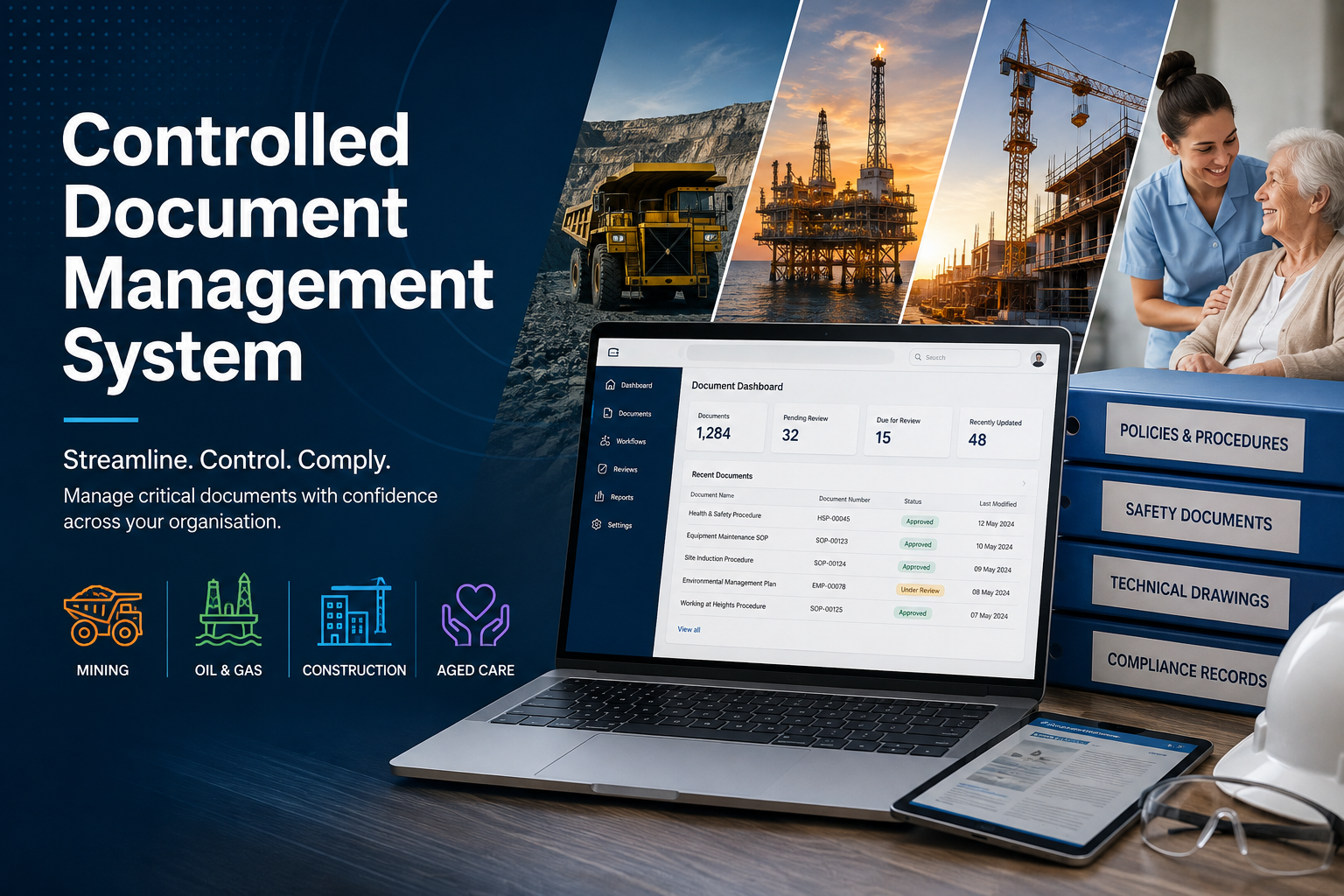
Organisations in highly regulated and document-intensive industries manage a large volume of critical information every day. Policies, procedures, work instructions, technical drawings, safety documents and compliance records all need to remain accurate, secure and accessible.
For industries such as mining, oil and gas, construction and aged care, using outdated or uncontrolled documents can create operational risks, compliance challenges and inefficiencies.
A Controlled Document Management System provides a structured way to create, review, approve, distribute, track and archive important business documents. Instead of relying on shared drives, email attachments and paper-based processes, organisations can use centralised control document management software to maintain document accuracy, improve compliance and strengthen information governance.
Ulysses is Monarch360’s controlled document management system for SharePoint Online and Microsoft 365. Book a demo.
What Is a Controlled Document Management System?
A Controlled Document Management System is a software solution designed to ensure that business-critical documents are created, reviewed, approved, distributed and maintained according to defined processes.
Unlike basic file storage, a controlled document system provides greater visibility and control over:
Document versions
Review and approval processes
Document ownership
Access permissions
Changes and revisions
Audit history
Document status
Retention and archival
Controlled distribution
This is particularly important for organisations that manage documents which must remain accurate, current and compliant.
For example, employees may need access to the latest approved procedure, safety policy, technical specification or work instruction. A controlled document management system helps ensure they are not relying on outdated versions stored in emails, shared folders or local devices.
Why Control Document Management Software Matters
Managing controlled documents manually can become increasingly difficult as an organisation grows.
Documents may be stored across network drives, SharePoint sites, individual computers, email inboxes and physical filing systems. This can create uncertainty about which document is the latest version and whether it has been reviewed and approved.
Modern control document management software centralises these processes and provides greater control over the entire document lifecycle.
1. Version Control
Version control helps prevent employees from accidentally using outdated documents.
Every revision can be tracked, allowing authorised users to identify what changed and when the document was updated.
This is particularly valuable for:
Policies and procedures
Standard operating procedures
Work instructions
Safety documents
Technical drawings
Engineering specifications
Compliance documentation
Risk assessments
Quality management documents
Training materials
2. Review and Approval Workflows
Documents can be routed through predefined review and approval processes.
A typical workflow may look like:
Create → Review → Approve → Publish → Review Again → Archive
This creates a consistent process and reduces the risk of important documents being published or used without appropriate approval.
Automated workflows can also help organisations manage scheduled reviews and document updates more efficiently.
3. Controlled Access
Not every employee needs access to every document.
A controlled document management platform can use permissions and security controls to help ensure that sensitive or confidential information is available only to authorised users.
This can be particularly important for organisations managing commercial information, employee records, technical documentation and sensitive operational data.
4. Audit Trails
An audit trail provides visibility into document activity.
Organisations can maintain records of important actions such as:
Document creation
Modifications
Reviews
Approvals
Access activity
Publishing
Archiving
This improves accountability and helps organisations demonstrate how important information has been managed.
5. Faster Document Retrieval
Employees should not have to search through multiple folders or email conversations to find an important document.
Centralised document management with structured metadata and search capabilities makes it easier to locate information when it is needed.
This can improve productivity and reduce the time employees spend searching for policies, procedures, drawings and other critical documents.
Controlled Document Management for the Mining Industry
Mining organisations operate in complex environments where safety, operational procedures and compliance documentation are essential.
Mining companies may manage large volumes of documents across multiple locations, departments and operational sites.
These documents can include:
Standard operating procedures
Safety procedures
Risk assessments
Environmental documentation
Equipment maintenance procedures
Technical specifications
Inspection reports
Incident documentation
Training materials
Compliance documents
A Controlled Document Management System can help mining organisations maintain a central source of approved and current documentation.
Employees and contractors can access the information they need while document owners maintain greater control over versioning, approvals and distribution.
Benefits for Mining Organisations
A controlled document management solution can help mining organisations:
Reduce the risk of outdated procedures being used
Improve access to approved documentation
Strengthen document control across multiple sites
Maintain document review and approval processes
Improve audit readiness
Support compliance requirements
Provide greater visibility into document changes
Improve collaboration between operational teams
For organisations managing documents across remote sites and large workforces, controlled access to current information can be essential for operational efficiency and consistency.
Controlled Document Management for Oil and Gas
The oil and gas industry manages complex operational, engineering and compliance documentation.
Documents often need to be reviewed and updated by multiple stakeholders, including engineers, operations teams, safety professionals and management.
Examples of controlled documents may include:
Operating procedures
Engineering specifications
Technical drawings
Safety documentation
Maintenance procedures
Inspection reports
Risk assessments
Environmental procedures
Compliance documentation
Emergency response procedures
A centralised control document management software solution can help organisations manage these documents throughout their lifecycle.
Improving Document Compliance and Traceability
Oil and gas organisations often need to demonstrate that important procedures and documents have been reviewed, approved and maintained correctly.
A Controlled Document Management System can provide:
Document version history
Approval workflows
Review schedules
Audit trails
Access controls
Controlled distribution
Centralised document storage
This helps organisations maintain greater visibility over their critical business information.
By reducing reliance on uncontrolled copies stored across different systems, teams can work with more confidence that they are accessing approved and current documentation.
Controlled Document Management for Construction
Construction projects generate significant volumes of documents throughout their lifecycle.
From project planning and design through to construction and handover, teams need access to accurate and current information.
Construction documents may include:
Project plans
Technical drawings
Engineering documents
Specifications
Work instructions
Safety procedures
Quality documentation
Inspection reports
Contracts
Compliance records
Project correspondence
Managing these documents manually can create confusion when multiple versions are being shared between project teams, contractors and stakeholders.
Managing Drawings and Project Documentation
Version control is particularly important within construction environments.
Using an outdated drawing or specification can lead to mistakes, delays and additional project costs.
A Controlled Document Management System can help organisations:
Maintain current versions of project documents
Track document revisions
Manage approval workflows
Control access to sensitive information
Improve document distribution
Maintain a history of document changes
Reduce reliance on email attachments
This provides project teams with greater confidence that they are working with the correct information.
Improving Collaboration Across Construction Projects
Construction projects often involve multiple stakeholders.
Project managers, engineers, contractors, subcontractors and other teams may all need access to specific documents.
A centralised document management environment can improve collaboration while maintaining appropriate access controls.
Instead of distributing multiple copies of documents through email, organisations can provide authorised users with access to a central and controlled source of information.
Controlled Document Management for Aged Care
Aged care organisations manage important policies, procedures and operational documentation.
Maintaining accurate and current documentation can support consistent service delivery, staff training and organisational compliance.
Common documents may include:
Care policies and procedures
Staff procedures
Training materials
Quality management documents
Risk management procedures
Incident management procedures
Workplace safety documentation
Compliance documents
Operational policies
Clinical and care-related procedures
As policies and procedures are updated, it is important that employees have access to the latest approved version.
Improving Policy and Procedure Management
A Controlled Document Management System can help aged care organisations manage policies and procedures more effectively.
Documents can be created, reviewed and approved through structured workflows before being published to authorised users.
Version control helps organisations maintain a clear history of changes and ensures older versions can be archived when they are no longer current.
This can help reduce confusion and provide staff with a reliable source of approved information.
Supporting Compliance and Accountability
Aged care organisations need strong processes for managing policies and procedures.
A controlled document management environment can support:
Scheduled document reviews
Approval workflows
Version control
Audit trails
Controlled access
Document retention
Centralised policy management
These capabilities can help organisations maintain a more structured and accountable approach to managing important information.
Key Features to Look for in a Controlled Document Management System
When evaluating a Controlled Document Management System, organisations should consider more than basic file storage.
The right solution should support the full lifecycle of important business documents.
Document Version Control
The system should provide reliable version management so users can identify the latest approved document.
Older versions should be retained appropriately while ensuring employees can easily access the current version.
Workflow Automation
Automated workflows can reduce manual email communication and help ensure documents follow the correct review and approval process.
Workflows can also help organisations manage scheduled document reviews.
Search and Metadata
Users should be able to locate information quickly using metadata, keywords and structured classification.
Effective search functionality can reduce the time spent searching for important documents.
Permissions and Security
Role-based permissions can help protect sensitive information and control access to documents.
Different users and departments can be provided with access based on their responsibilities.
Audit History
A detailed activity history improves transparency and accountability.
Organisations can track important document activities throughout the lifecycle.
Retention Management
For organisations managing business records and compliance documentation, retention management can help support structured archival and disposal processes.
Mobile Access
For organisations with employees working across multiple locations, sites or remote environments, mobile access can help authorised users access important documents when required.
Microsoft 365 and SharePoint Integration
For organisations already using Microsoft 365, integration with SharePoint and other Microsoft technologies can make adoption easier.
Monarch360 positions its solutions within the Microsoft ecosystem and provides SharePoint and Microsoft 365-related solutions for organisations across Australia.
How Monarch360 Helps Organisations Manage Controlled Documents
Monarch360 provides solutions designed to help organisations modernise document and records management.
Its ULYSSES Controlled Document Management System is positioned for organisations that need to manage business-critical and controlled documents through a web-based application and mobile experience.
For broader electronic document and records management requirements, Monarch EDRMS provides functionality for managing documents and records throughout their lifecycle.
Monarch360 also highlights integration with Microsoft 365 and SharePoint, helping organisations connect document management with familiar Microsoft environments.
This approach can support organisations across industries including mining, oil and gas, construction and aged care that are looking to move away from fragmented document storage and establish a more structured information management environment.
Benefits of Moving From Manual Document Management
Organisations that rely heavily on manual document processes can face several challenges.
Documents may be difficult to locate, multiple versions may exist and approval processes can be managed through lengthy email conversations.
A modern document management environment can help deliver several benefits.
Better Productivity
Employees spend less time searching for files and managing manual approval processes.
Centralised information makes it easier for authorised users to locate the documents they need.
Improved Document Accuracy
Version control helps users identify current and approved documents.
This can reduce the risk of employees relying on outdated information.
Greater Accountability
Audit trails provide visibility into document activities.
Organisations can maintain a clearer record of document reviews, approvals and changes.
Stronger Information Governance
Structured classification, permissions and retention processes provide greater control over organisational information.
Reduced Paper Dependency
Digital workflows can reduce the need to print, physically distribute and manually file documents.
Organisations can move towards more efficient and paperless document processes.
Improved Collaboration
Teams can work with shared information without relying on multiple copies of documents distributed through email.
This can improve communication while maintaining appropriate document controls.
Why an Integrated Approach to Document Management Matters
Managing important documents across multiple disconnected systems can create information silos.
For example, an organisation may have:
A procedure stored in a shared drive
A newer version shared through email
Supporting documents stored in SharePoint
Approval records stored separately
Older versions stored on individual computers
This can make it difficult to determine which version is current and whether the document has been formally approved.
An integrated approach provides a central and structured environment for managing documents throughout their lifecycle.
This can help organisations improve visibility, accountability and access to important business information.
A Smarter Digital Workplace With Monarch360
Digital transformation is changing how organisations manage information.
Instead of treating documents as individual files stored across multiple systems, organisations can manage information as part of a structured lifecycle.
For mining, oil and gas, construction and aged care organisations, effective document control can help improve operational efficiency, collaboration and information governance.
Monarch360's solutions are designed around the Microsoft ecosystem and focus on document management, records management and digital workplace requirements.
The company is based in Perth, Western Australia, and provides enterprise software solutions for organisations across Australia.
Whether an organisation needs to improve document control, manage policies and procedures or modernise information management processes, selecting the right technology can help create a more efficient and accountable digital workplace.
Conclusion
A Controlled Document Management System provides organisations with greater control over important business information.
With version control, approval workflows, permissions, audit trails and structured document management, organisations can reduce the risks associated with outdated, duplicated or misplaced documents.
For industries such as mining, oil and gas, construction and aged care, effective document control can support better access to information, stronger accountability and more structured compliance processes.
By moving away from fragmented document storage and manual processes, organisations can create a central source of approved and current information.
Monarch360 provides solutions including ULYSSES and Monarch EDRMS to help organisations modernise document management, records management and digital workplace processes.
Frequently Asked Questions
What is a Controlled Document Management System?
A Controlled Document Management System is software that manages the creation, review, approval, distribution, versioning and lifecycle of business-critical documents.
What is control document management software?
Control document management software helps organisations maintain accurate and approved documents through version control, workflows, permissions, audit trails and structured document processes.
Why is document control important for mining organisations?
Mining organisations manage important safety, operational and compliance documents. Document control helps ensure employees and authorised users can access the latest approved information.
How does a Controlled Document Management System help oil and gas organisations?
It can help oil and gas organisations manage operational procedures, engineering documents, safety documentation and compliance information through structured version control, workflows and audit trails.
Why is version control important in construction?
Construction projects involve drawings, specifications and project documents that may be regularly updated. Version control helps teams identify and access the latest approved version.
How can aged care organisations benefit from controlled document management?
Aged care organisations can use controlled document management to manage policies, procedures, training documents and other important operational information through structured review, approval and version control processes.
What is the difference between document management and records management?
Document management focuses on managing documents throughout their active lifecycle, while records management focuses on preserving information as evidence and managing its retention and disposal.
Can controlled document management software integrate with Microsoft 365?
Yes. Modern document management solutions can integrate with Microsoft 365 and SharePoint. Monarch360 specifically provides solutions within the Microsoft ecosystem.
Who can benefit from a Controlled Document Management System?
Organisations across mining, oil and gas, construction, aged care and other document-intensive industries can benefit from controlled document management.
What features should a Controlled Document Management System include?
Important features may include version control, approval workflows, permissions, audit trails, metadata, search capabilities, retention management and integration with existing business systems.
Ready to Improve Your Document Control?
If your organisation needs better control over policies, procedures, technical documents, compliance information or other business-critical documents, Monarch360 can help you explore a modern approach to document and information management.
Contact Monarch360 to discuss your controlled document management, records management or Microsoft 365 requirements.
