

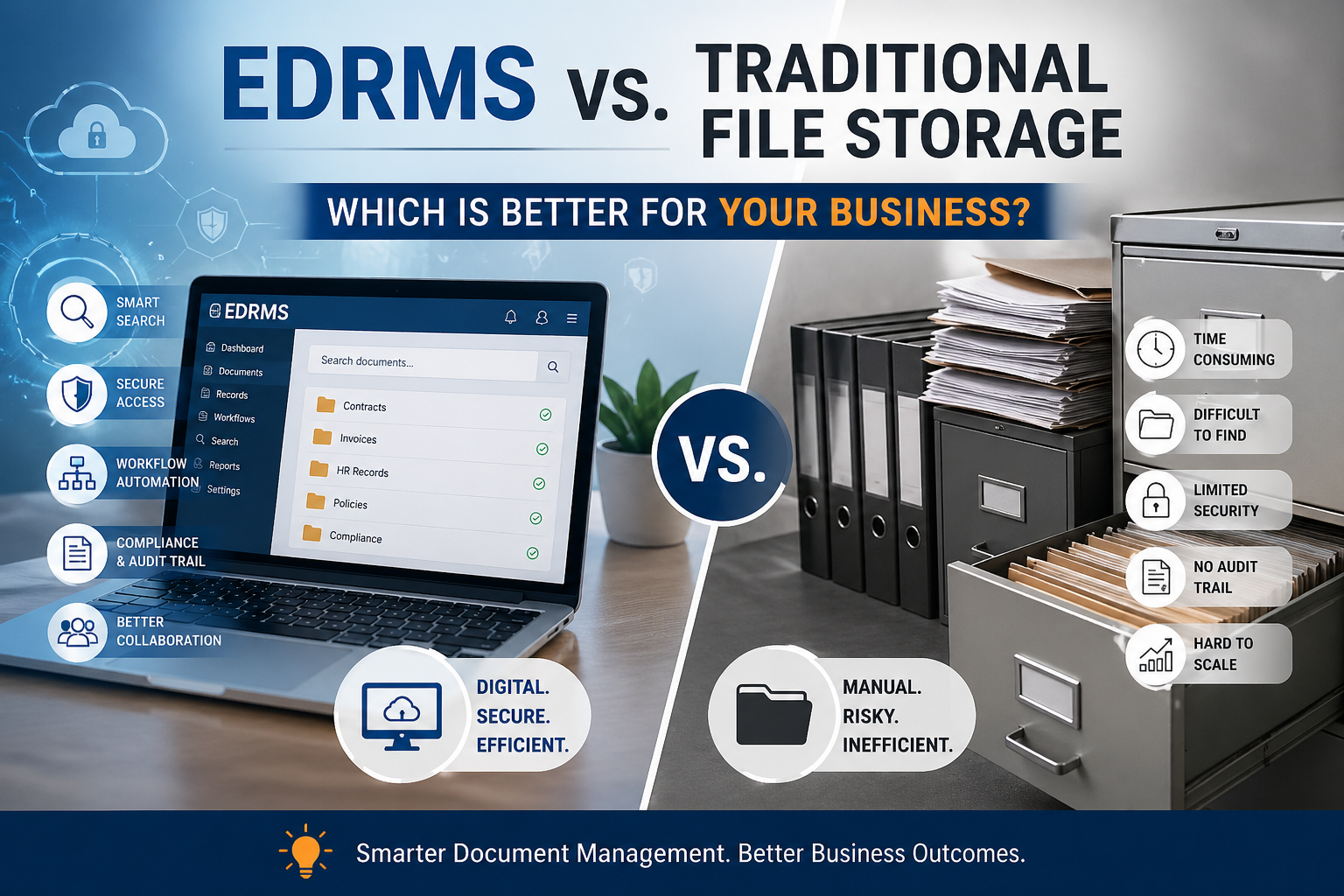
In today’s digital-first world, businesses generate and manage vast amounts of information every day. From contracts and invoices to emails and compliance records, how you store and manage this data can significantly impact your efficiency, security, and growth. Two common approaches are Electronic Document and Records Management Systems (EDRMS) and traditional file storage systems. But which one is better for your business?
Let’s break it down.
What Is Traditional File Storage?
Traditional file storage refers to methods like physical filing cabinets, shared drives, and basic folder-based systems. These systems organize files in hierarchical structures, either physically or digitally.
While simple and familiar, traditional storage systems often lack advanced features such as automation, compliance tracking, and intelligent search. Files are typically stored in folders without structured metadata, making retrieval time-consuming and error-prone.
What Is an EDRMS?
An Electronic Document and Records Management System (EDRMS) is a specialised software designed to capture, store, manage, and track documents and records throughout their lifecycle. It ensures records are secure, compliant, and easily retrievable.
Solutions like Monarch EDRMS provide advanced capabilities such as automated workflows, metadata classification, secure access controls, and audit trails. Built on platforms like Microsoft 365 and SharePoint, these systems streamline how organizations manage information.
Key Differences Between EDRMS and Traditional File Storage
1. Organisation and Searchability
Traditional systems rely on folder structures, which can become messy over time. Finding a specific document often depends on knowing where it was saved.
EDRMS, on the other hand, uses metadata, tags, and advanced search tools. This allows users to locate documents instantly, even without knowing their exact location.
2. Security and Access Control
In traditional systems, security is limited to basic permissions or physical locks. This increases the risk of unauthorized access or data loss.
EDRMS offers granular access control, encryption, and audit trails. For example, documents can be locked, tracked, and accessed only by authorized users, ensuring better data protection.
3. Compliance and Recordkeeping
Compliance is a major challenge with traditional storage. There’s little control over retention policies, versioning, or audit tracking.
EDRMS is built for compliance. It ensures records are stored according to regulations, with retention schedules, version history, and audit logs. This is crucial for industries like government, healthcare, and finance.
4. Workflow Automation
Traditional systems require manual processes printing, signing, scanning, and emailing documents.
EDRMS automates workflows such as approvals, reviews, and document routing. Systems like Monarch EDRMS include automated approval processes and notifications, improving efficiency and reducing human error.
5. Collaboration and Accessibility
Traditional file storage often limits collaboration, especially for remote teams.
EDRMS enables real-time collaboration, allowing multiple users to access and work on documents simultaneously. Cloud-based platforms ensure accessibility from anywhere, boosting productivity.
6. Scalability
As businesses grow, traditional systems become harder to manage. File duplication, storage limitations, and disorganization become common issues.
EDRMS is highly scalable. It can handle large volumes of data while maintaining structure and performance, making it ideal for growing organizations.
Advantages of EDRMS
Centralized document storage
Faster document retrieval
Improved security and compliance
Automated workflows
Enhanced collaboration
Reduced paper usage and operational costs
Limitations of Traditional File Storage
Difficult to scale
Prone to human error
Limited security features
Time-consuming document retrieval
Lack of compliance tools
Are There Any Drawbacks to EDRMS?
While EDRMS offers significant advantages, it’s not without challenges. Implementation requires planning, training, and investment. Users may need time to adapt to new systems, and not all records are automatically captured without proper processes in place.
However, these challenges are often outweighed by long-term efficiency gains and risk reduction.
Which Is Better for Your Business?
The answer depends on your business needs.
Small businesses with minimal documentation may manage with traditional systems temporarily.
Growing or compliance-driven organizations will benefit significantly from EDRMS.
Enterprises handling sensitive data should prioritize EDRMS for security and governance.
In most cases, EDRMS is the better long-term solution. It not only improves efficiency but also ensures your business is future-ready in a digital environment.
Conclusion
Choosing between EDRMS and traditional file storage is not just about storing documents—it’s about how effectively your business manages information. While traditional systems may seem simpler, they lack the capabilities required in today’s fast-paced, compliance-driven world.
Modern solutions like Monarch EDRMS offer a smarter, more secure, and scalable way to handle documents. By investing in an EDRMS, businesses can streamline operations, reduce risks, and unlock greater productivity.
Frequently Asked Questions
1. What is the main difference between EDRMS and traditional file storage?
EDRMS uses structured metadata, automation, and compliance features, while traditional storage relies on basic folder systems with limited functionality.
2. Is EDRMS suitable for small businesses?
Yes, especially if the business handles growing volumes of documents or needs better organization and security.
3. Can EDRMS integrate with existing tools?
Many EDRMS solutions, including Monarch EDRMS, integrate with platforms like Microsoft 365 and SharePoint for seamless workflows.
4. Does EDRMS improve data security?
Yes, it provides advanced security features such as access controls, encryption, and audit trails to protect sensitive information.
5. Is it difficult to switch from traditional storage to EDRMS?
The transition requires planning and training, but with proper implementation, businesses can quickly adapt and benefit from improved efficiency and control.
