

Dynamics 365 vs Traditional CRM: Which CRM Is Right for Your Business in 2026?
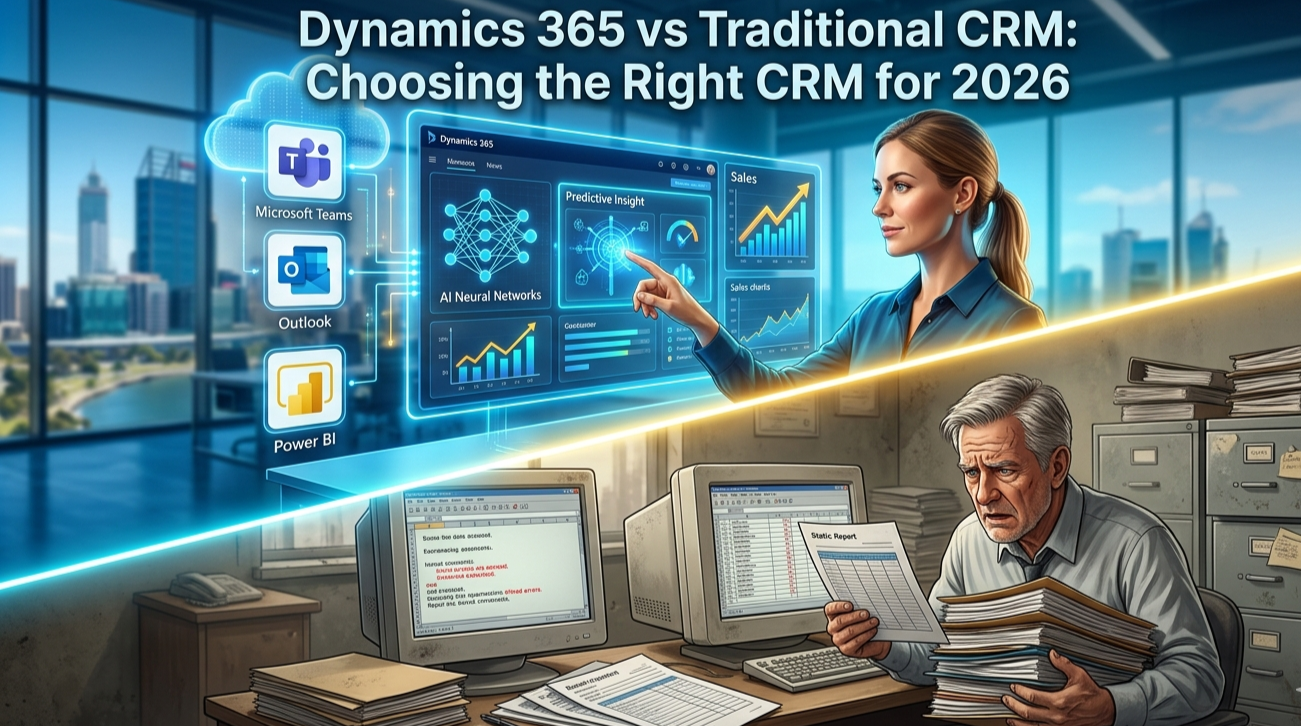
Choosing the right customer relationship management (CRM) platform is one of the most important technology decisions Australian businesses will make in 2026.
As customer expectations continue to evolve, organisations need more than a simple database to manage contacts and sales activities. Modern businesses require automation, real-time insights, seamless collaboration, and the ability to scale efficiently.
Many organisations across Australia still rely on legacy CRM systems that were implemented years ago. While these platforms may meet basic requirements, they often struggle to support today's digital-first business environment.
This guide compares traditional CRM systems with Microsoft Dynamics 365 Customer Engagement, helping you determine which solution best aligns with your business goals.
What Is a Traditional CRM?
Traditional CRM platforms are designed primarily to store and organise customer information.
Common features include:
Contact and account management
Basic sales tracking
Manual task management
Standard reporting capabilities
Limited workflow automation
While these systems can support fundamental customer management processes, they often operate in isolation from other business applications.
Common limitations of traditional CRM platforms include:
Manual data entry
Limited integration capabilities
Static reporting dashboards
High customisation costs
Difficulty scaling with business growth
Limited mobile functionality
For growing organisations, these challenges can impact productivity, customer experience, and decision-making.
What Is Microsoft Dynamics 365?
Microsoft Dynamics 365 is a cloud-based business application platform that combines CRM capabilities with advanced automation, analytics, and AI-driven insights.
Built on the Microsoft ecosystem, Dynamics 365 integrates seamlessly with tools many organisations already use, including:
Microsoft Teams
Microsoft Outlook
Microsoft Power BI
Microsoft Power Automate
Microsoft 365
With modular applications covering sales, customer service, marketing, field service, and customer insights, organisations can implement only the functionality they need and expand over time.
Dynamics 365 vs Traditional CRM: Key Differences
| Feature | Dynamics 365 | Traditional CRM |
|---|---|---|
| Deployment | Cloud-based | Often on-premises |
| Automation | Advanced workflows and AI | Limited automation |
| Integrations | Native Microsoft integrations | Third-party connectors |
| Reporting | Real-time dashboards | Static reports |
| Customisation | Low-code development | Developer-dependent |
| Mobile Access | Full-featured mobile apps | Limited functionality |
| Scalability | Modular and flexible | Complex upgrades |
| Analytics | Embedded business intelligence | Basic reporting |
1. Automation and AI Capabilities
Modern businesses need to reduce repetitive tasks and enable teams to focus on higher-value activities.
Dynamics 365 offers built-in automation features that can:
Automate lead assignment
Trigger follow-up activities
Generate reminders and notifications
Route customer enquiries automatically
Forecast sales performance
With AI-powered insights, sales teams can prioritise opportunities and identify customer trends more effectively.
Traditional CRM systems often rely heavily on manual processes, increasing administrative workloads and creating opportunities for human error.
2. Integration Across Business Systems
Disconnected systems create data silos and reduce productivity.
Dynamics 365 integrates natively with the Microsoft ecosystem, enabling employees to work within familiar applications.
For example, users can:
Track emails directly from Outlook
Collaborate through Teams
Build workflows with Power Automate
Create dashboards using Power BI
Access customer information within Microsoft 365
Traditional CRM systems typically require custom integrations that increase implementation complexity and ongoing maintenance costs.
3. Customisation Without Complex Development
Every organisation has unique processes and requirements.
Dynamics 365 enables businesses to customise forms, workflows, dashboards, and applications using low-code tools through the Microsoft Power Platform.
This allows organisations to adapt quickly as requirements evolve.
Traditional CRM platforms often require specialised developers for even minor modifications, resulting in longer implementation timelines and higher costs.
4. Scalability for Growing Organisations
Business requirements rarely remain static.
Dynamics 365 uses a modular licensing model, allowing organisations to start with essential functionality and expand when needed.
Businesses can add capabilities such as:
Customer Service
Marketing
Field Service
Finance
Supply Chain Management
This flexibility helps organisations avoid costly system replacements as they grow.
Traditional CRM solutions may require significant upgrades or migration projects when additional functionality is needed.
5. Real-Time Reporting and Insights
Effective decision-making depends on accurate and timely information.
Dynamics 365 provides real-time visibility into:
Sales pipelines
Customer interactions
Service performance
Marketing activities
Team productivity
By integrating with Power BI, organisations can create customised dashboards that deliver actionable insights.
Traditional CRM reporting is often limited to predefined reports that require manual updates.
Why Australian Businesses Are Moving to Dynamics 365
Australian organisations are increasingly adopting cloud-based business applications to improve efficiency and support hybrid work environments.
Key reasons include:
Better collaboration across teams
Reduced manual administration
Improved customer experiences
Greater flexibility and scalability
Enhanced security and compliance capabilities
Seamless integration with existing Microsoft investments
For organisations already using Microsoft 365, Dynamics 365 can significantly simplify technology management.
Data Security and Compliance Considerations
Data security remains a top priority for Australian businesses.
Microsoft provides robust security capabilities, including:
Multi-factor authentication
Role-based access controls
Data encryption
Audit logging
Threat protection tools
Organisations can also leverage Microsoft Azure's Australian data centres to support local compliance requirements and data residency preferences.
Businesses should always evaluate their specific industry obligations and seek professional guidance when implementing CRM solutions.
When a Traditional CRM May Still Be Suitable
Traditional CRM platforms can still be effective for organisations with relatively simple requirements.
A traditional CRM may be appropriate if you:
Operate a small business with basic contact management needs
Have limited automation requirements
Use very few integrated applications
Have minimal reporting requirements
Need a lower-cost entry point
However, organisations with ambitious growth plans often outgrow traditional systems over time.
How to Choose the Right CRM
Consider the following questions before making your decision:
Does your organisation already use Microsoft 365?
Do your teams spend significant time on manual tasks?
Do you need real-time reporting and insights?
Will your business requirements change over the next three to five years?
Do you require mobile access for remote teams?
Do you need integrations with existing systems?
If you answered "yes" to most of these questions, Dynamics 365 may provide greater long-term value.
Why Work with Monarch360?
Successful CRM implementation requires more than software selection.
At Monarch360, we help Australian organisations design, implement, and optimise Microsoft business applications that align with their goals.
Our services include:
CRM strategy and consulting
Dynamics 365 implementation
Data migration and integration
Custom workflow automation
User training and adoption support
Ongoing optimisation and managed services
Based in Perth, our team understands the unique challenges faced by Australian organisations and delivers local support throughout every stage of your digital transformation journey.
Conclusion
Choosing between Dynamics 365 and a traditional CRM depends on your organisation's goals, processes, and growth plans.
While traditional CRM systems can support basic customer management, modern organisations increasingly require automation, advanced analytics, seamless integrations, and scalable technology.
For businesses seeking to improve customer experiences, streamline operations, and enable future growth, Dynamics 365 offers a flexible and intelligent platform built for the evolving workplace.
If you're evaluating your CRM options, partnering with an experienced implementation provider can help you maximise value and accelerate adoption.
Contact Monarch360 today to discuss your CRM requirements and discover how Dynamics 365 can support your business objectives.
Frequently Asked Questions
What is the difference between Dynamics 365 and traditional CRM systems?
Dynamics 365 provides cloud-based CRM capabilities with built-in automation, AI-powered insights, real-time reporting, and native Microsoft integrations. Traditional CRM systems typically focus on contact management and basic sales processes.
Is Dynamics 365 suitable for small businesses?
Yes. Dynamics 365 offers flexible licensing options that allow small businesses to start with essential functionality and scale as their needs evolve.
Can Dynamics 365 integrate with existing business systems?
Yes. Dynamics 365 integrates with Microsoft applications and many third-party systems through APIs and the Microsoft Power Platform.
How long does a Dynamics 365 implementation take?
Implementation timelines vary depending on complexity, customisation requirements, and data migration needs. Small projects may take a few weeks, while enterprise deployments can take several months.
Does Dynamics 365 support mobile users?
Yes. Dynamics 365 includes mobile applications that enable employees to access customer information, update records, and collaborate from any location.
Can Dynamics 365 help improve customer service?
Yes. Dynamics 365 provides tools for case management, omnichannel engagement, knowledge management, and customer insights to help organisations deliver better service experiences.
